Fierce Patriot by Robert L. O'Connell
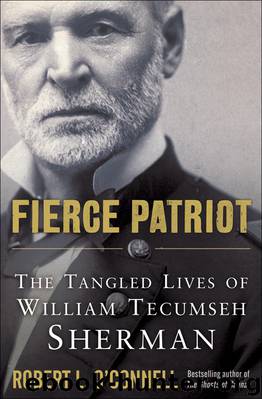
Author:Robert L. O'Connell [O’Connell, Robert L.]
Language: eng
Format: epub
ISBN: 978-0-679-60469-3
Publisher: Random House Inc.
Published: 2014-06-30T16:00:00+00:00
Chapter VIII
BANDS OF STEEL
1
WILLIAM TECUMSEH SHERMAN’S central historical importance is derived from his role in the physical consolidation of transcontinental America. But it was chance that tilted him in this direction; his own awareness of his part in the process evolved and intensified only gradually. There exist no fantasy maps drawn during his days at West Point, no sophomoric verse eulogizing westward expansion. In Florida he was little more than an observer, though an acute one. But in California, along with all its frustrations, he seems to have first caught a glimpse of a transcontinental mission and what was required. In 1859, the long report he had composed for his brother John on the possibility of a transcontinental railroad had generated quite a stir in Washington. Then the South seceded, and Sherman waged a four-year vendetta to knock it back into the Union, a defining experience that only intensified his yen for national spaciousness.1 From this point, he became Manifest Destiny’s chief of operations, orchestrating the construction of the four great bands of steel, the transcontinental railroads that would tie everything together coast-to-coast, from sea to shining sea. It was his final act, his culminating achievement, and one he felt did the country more good than his services during the Civil War.2 But as that conflict ended, Sherman’s future was far from assured.
In large part, it was his own professional focus and his disdain for politics that saved him. Sherman had no interest in Reconstruction or its enforcement, and everybody in Washington knew it. His only interest in the brewing battle between Edwin Stanton, the embodiment of the Radicals, and President Johnson was to avoid it. He had his own plan, to a military strategist something far more intellectually challenging, and for the most part he had the good sense to stick to it.
And of course, he had Grant to cover him. Grant was interested in politics—he wanted to be president—but he was also farsighted enough to realize the criticality of the transcontinental project. Who better to oversee it than the most brilliant and reliable of wingmen? The obvious stumbling block was the secretary of war, “as vindictive as old satan,” Sherman assumed.3 But not necessarily. As general of the army, Grant was technically subordinate to Stanton, but in terms of stature he towered over everybody in Washington, and he wanted harmony. Stanton had bigger things to think about, such as trying to carve out a future for African Americans. This was a reasonable solution; if nothing else, it would remove the offending Sherman and send him far to the west. So it was to be that General Orders No. 118 of June 27, 1865, designated Major General W. T. Sherman to command the vast Military Division of the Mississippi, extending out to the crest of the Rockies and north and south from Canada to the Mexican border, to be headquartered at (where else?) St. Louis.4
Technically, the program had been under way since July 1, 1862, when Lincoln signed the
Download
This site does not store any files on its server. We only index and link to content provided by other sites. Please contact the content providers to delete copyright contents if any and email us, we'll remove relevant links or contents immediately.
| Africa | Americas |
| Arctic & Antarctica | Asia |
| Australia & Oceania | Europe |
| Middle East | Russia |
| United States | World |
| Ancient Civilizations | Military |
| Historical Study & Educational Resources |
Cat's cradle by Kurt Vonnegut(15365)
Pimp by Iceberg Slim(14523)
4 3 2 1: A Novel by Paul Auster(12405)
Underground: A Human History of the Worlds Beneath Our Feet by Will Hunt(12101)
The Radium Girls by Kate Moore(12036)
Wiseguy by Nicholas Pileggi(5795)
The Fire Next Time by James Baldwin(5454)
Perfect Rhythm by Jae(5415)
American History Stories, Volume III (Yesterday's Classics) by Pratt Mara L(5312)
Paper Towns by Green John(5196)
Pale Blue Dot by Carl Sagan(5013)
A Higher Loyalty: Truth, Lies, and Leadership by James Comey(4967)
The Mayflower and the Pilgrims' New World by Nathaniel Philbrick(4509)
The Doomsday Machine by Daniel Ellsberg(4493)
Killers of the Flower Moon: The Osage Murders and the Birth of the FBI by David Grann(4451)
The Sympathizer by Viet Thanh Nguyen(4398)
Too Much and Not the Mood by Durga Chew-Bose(4353)
The Borden Murders by Sarah Miller(4330)
Sticky Fingers by Joe Hagan(4208)
